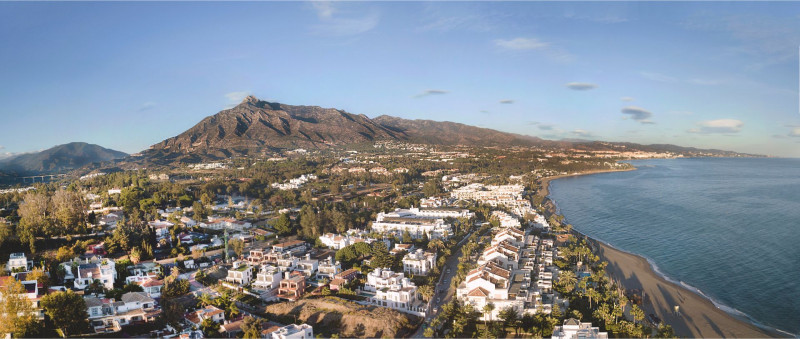
Nueva Andalucía has established itself as one of Marbella's most sought-after residential areas. Nestled between Puerto Banús and the San Pedro de Alcántara district, this expansive urbanisation attracts international buyers looking for a lifestyle that blends championship golf, modern amenities and year-round Mediterranean sunshine.
Known widely as Golf Valley, the area earned its nickname through the concentration of world-class courses that define its landscape and rhythm of daily life. The residential character ranges from contemporary villas with mountain views to modern apartments near the coast, creating diverse options for different budgets and lifestyle preferences.
For overseas buyers navigating the Spanish property market for the first time, understanding local procedures matters as much as finding the right home. Property transaction support helps buyers move through the legal and administrative steps with confidence.
This guide examines what makes Nueva Andalucía attractive to property buyers in 2026, the community infrastructure that supports residents, and the practical steps involved in purchasing a home here.
Nueva Andalucía Development History: From Farmland to Golf Valley
Understanding Nueva Andalucía's evolution provides context for its current market position and residential character.
1960s-1970s: Initial Development
José Banús, the developer behind Puerto Banús marina, acquired agricultural land northwest of the marina and began transforming it into a residential district. Early development focused on creating villa plots and establishing the first golf courses, laying groundwork for what would become Golf Valley.
1980s: Golf Course Expansion
Aloha Golf Club opened in 1975, followed by Las Brisas and Los Naranjos in the early 1980s. This concentration of championship courses within a small geographic area created the Golf Valley identity and attracted affluent international buyers seeking second homes near world-class sporting facilities.
1990s: Community Infrastructure
As the permanent resident population grew, commercial centres emerged to serve daily needs. Centro Plaza became the area's commercial heart, providing supermarkets, medical services and restaurants. The establishment of international schools cemented Nueva Andalucía's transition from seasonal resort to year-round residential community.
2000s: Apartment Development and Diversification
Developers began filling gaps between villa estates with apartment complexes and townhouse communities. Gated developments with shared amenities expanded the buyer pool beyond ultra-high-net-worth villa purchasers, creating a more diverse demographic mix.
2010s: Post-Crisis Modernisation
Following Spain's property market correction, Nueva Andalucía saw renovation of older villa stock and construction of contemporary architectural projects. The area maintained value better than many coastal zones due to Golf Valley's established reputation and infrastructure depth.
2020s-Present: Premium Market Positioning
By 2026, Nueva Andalucía occupies the premium tier of Marbella's residential market, positioned between Puerto Banús ultra-luxury and more affordable zones further from the coast. Continued investment in course maintenance, community facilities and infrastructure supports stable property values and strong rental yields for investors.
This development trajectory created layered housing stock, from 1970s villas on large plots to cutting-edge contemporary homes, giving buyers varied options within a mature, established community.
The Golf Valley: Courses and Lifestyle
Golf Valley centres around several championship courses that shape both the visual landscape and the social fabric of Nueva Andalucía. Aloha Golf Club remains one of the area's cornerstone facilities, alongside Las Brisas and Los Naranjos, courses that host international tournaments and offer year-round play.
The courses create more than sporting venues. They establish green corridors throughout the residential zones, maintain property values and provide gathering points for the international community that calls Nueva Andalucía home. Many villas and apartments offer golf-course views or direct access to fairways, a feature that commands premium pricing in the local market.
Beyond the greens, the Golf Valley lifestyle encompasses tennis clubs, fitness facilities and social clubs that cater to an active, internationally minded population. The density of these facilities within a concentrated area makes Nueva Andalucía particularly appealing to buyers who want amenities within walking or short driving distance.
For retirees and second-home owners, the golf-centred social calendar provides structure and community without the intensity of full-time work commitments. For families, the clubs offer youth programmes and supervised activities alongside adult facilities.
Property Types and Neighbourhoods in Nueva Andalucía
Nueva Andalucía spans a large area with distinct neighbourhoods, each offering different property styles and price points.
The Golf Valley proper contains many of the area's luxury villas, often situated on generous plots with mature gardens and private pools. These properties typically range from traditional Andalusian-style homes to contemporary architectural statements with floor-to-ceiling glass and minimalist design.
Closer to the coast, developments such as Aloha Gardens and Los Naranjos offer apartment and townhouse options. These communities often include shared pools, landscaped gardens and security features, appealing to buyers who want lower-maintenance properties or lock-and-leave convenience.
The neighbourhood closest to Puerto Banús attracts buyers prioritising proximity to marina nightlife and luxury retail. Properties here command higher per-square-metre prices reflecting the location premium.
Inland areas near Centro Plaza and the commercial spine along Avenida del Prado offer more affordable entry points, with apartments and townhouses that still provide access to Nueva Andalucía's amenities and community feel.
Property Price Comparison Across Nueva Andalucía Zones
Understanding pricing variations across Nueva Andalucía's neighbourhoods helps buyers align budget with location priorities.
Neighbourhood | Property Type | Average Price per m² | Typical Property Size | Price Range |
|---|---|---|---|---|
Golf Valley Villas | Detached villa | €4,200-€5,800 per m² | 300-600 m² | €1.26M-€3.48M |
Aloha Gardens Apartments | 2-3 bed apartment | €3,600-€4,200 per m² | 100-150 m² | €360K-€630K |
Puerto Banús Proximity Zone | Luxury apartment/penthouse | €5,500-€7,200 per m² | 120-200 m² | €660K-€1.44M |
Centro Plaza Inland Areas | Townhouse/apartment | €2,800-€3,400 per m² | 90-140 m² | €252K-€476K |
These figures reflect 2026 market conditions in Nueva Andalucía. The Puerto Banús proximity premium adds 30-50 percent to comparable properties located further inland. Golf Valley villas with course frontage or mountain views command the highest per-square-metre rates, while inland locations near commercial centres offer the most affordable entry points.
Renovation condition significantly affects pricing within each zone. Newly built or recently renovated properties fetch premium rates, while older stock requiring updates trades at discounts of 15-25 percent below zone averages.
Understanding these neighbourhood distinctions helps buyers match their budget and lifestyle requirements to the right property location.
Community Services and Infrastructure
Nueva Andalucía functions as a self-contained community with infrastructure that supports full-time residents rather than serving only as a holiday destination.
Centro Plaza forms the commercial heart, housing supermarkets including Mercadona and Supercor, banks, pharmacies, medical clinics and a variety of restaurants. This central location means residents can manage daily errands without travelling to Marbella town centre or other nearby areas.
Healthcare services include private clinics and dental practices, with the larger Hospital Costa del Sol within a short drive. Many medical professionals speak English and other European languages, reflecting the international patient base.
The area benefits from well-maintained roads and regular public transport links to Marbella, Puerto Banús and San Pedro, though most residents rely on private vehicles for daily transport. Málaga Airport sits approximately 60 kilometres east, accessible via the A-7 coastal road or the faster AP-7 toll motorway.
Postal services, banking and administrative facilities operate within Nueva Andalucía, reducing the need to travel elsewhere for routine business.
Utility provision meets Northern European standards, with reliable electricity, water and high-speed internet available throughout residential zones. Fibre-optic broadband reaches most developments, supporting remote work arrangements increasingly common among international residents.
Schools and Family Facilities
International families form a significant portion of Nueva Andalucía's resident population, and the area has developed educational infrastructure to match.
Aloha College and other international schools in the immediate vicinity offer British, American and International Baccalaureate curricula. These institutions educate children from early years through secondary level, providing continuity for families relocating from other countries.
Spanish-language schools also operate nearby for families who prefer national education or want their children to integrate more fully into local culture.
Childcare facilities, including nurseries and pre-schools, support working parents and families with younger children.
Playgrounds, sports facilities and family-oriented activities cluster around the residential areas, creating a child-friendly environment unusual in resort-focused coastal zones. Many gated communities maintain their own play areas and pools with shallow sections suitable for young children.
Families considering Nueva Andalucía should research specific schools early, as popular institutions often maintain waiting lists and require advance registration. School fees vary considerably, with annual costs ranging from €6,000 to €15,000 depending on institution and year level.
The concentration of international families creates social networks that help newcomers integrate quickly. Parent groups, sports clubs and community associations provide ready-made connections for families establishing themselves in the area.
Shopping, Dining and Entertainment
Nueva Andalucía offers a restaurant and entertainment scene that reflects its international population.
Dining options span traditional Spanish tapas bars, Italian restaurants, Asian fusion venues and British pubs, many clustered around Centro Plaza and along the main commercial streets. The variety accommodates different tastes and budgets without requiring travel to Puerto Banús or Marbella.
For shopping, local boutiques and service providers cover everyday needs, while Puerto Banús sits a few minutes away for luxury retail. El Corte Inglés in Marbella provides department-store shopping for those who want a wider selection.
Entertainment includes live music venues, cinema options in nearby San Pedro, and the nightlife of Puerto Banús for those who seek it. The area maintains a more residential, family-friendly atmosphere than the marina itself, offering proximity to entertainment without the constant buzz.
Weekly markets provide fresh produce and artisan goods, contributing to the local flavour and supporting a lifestyle that balances international convenience with Mediterranean tradition.
The Saturday morning market at Centro Plaza attracts both residents and visitors, offering everything from organic vegetables to handmade crafts. This weekly ritual has become a social gathering point where neighbours meet over coffee and pastries from the surrounding cafés.
The Step-by-Step Buying Process in Nueva Andalucía
Purchasing property in Nueva Andalucía follows the Spanish legal framework with specific local considerations. Understanding each stage and typical timelines helps buyers plan their purchase and coordinate logistics.
Step 1: Research and Viewing (2-4 weeks)
Identify the neighbourhood and property type that match your requirements and budget. Attend viewings and assess condition, location and potential issues. Many buyers visit multiple times across different seasons to understand the area fully.
For overseas buyers, grouping viewings into intensive trips makes efficient use of travel time. Most estate agents accommodate concentrated viewing schedules when given advance notice.
Step 2: Make an Offer and Sign a Reservation Contract (3-7 days)
Once you find a suitable property, submit a written offer. If the seller accepts, both parties typically sign a reservation contract and you pay a small reservation deposit, usually €3,000-€6,000, holding the property off the market for a short period while legal checks proceed.
This reservation period typically lasts 7-14 days, giving you time to appoint legal representation and begin due diligence without losing the property to competing buyers.
Step 3: Engage a Lawyer (Immediate)
Appoint an independent Spanish lawyer, not connected to the seller or agent, to conduct due diligence. The lawyer verifies the property title at the Land Registry, checks for debts or charges registered against the property, confirms planning permissions and building licences, ensures the property matches cadastral records, and confirms the seller has legal right to sell.
Legal fees typically run 1-1.5 percent of the purchase price. Many lawyers on the Costa del Sol speak English and specialise in supporting international buyers, understanding the specific concerns of non-resident purchasers.
Step 4: Obtain an NIE Number (1-3 weeks)
All foreign buyers need a Número de Identidad de Extranjero for property transactions in Spain. Your lawyer can assist with the application, which processes through the local police station or Spanish consulate in your home country.
For buyers already in Spain, appointments at the Marbella foreigners' office can often be arranged within days. For those applying from abroad, consulate processing times vary by location and season, sometimes extending to three weeks during busy periods.
Step 5: Open a Spanish Bank Account (1-2 weeks)
You need a Spanish bank account to pay purchase costs, set up direct debits for utilities and property taxes, and receive rental income if you plan to let the property.
Most banks require your NIE, passport, proof of address in your home country, and documentation showing source of funds. Some banks additionally request references from your existing bank. Non-resident accounts typically incur higher maintenance fees than resident accounts.
Step 6: Arrange Financing (3-6 weeks)
If you require a mortgage, approach Spanish banks or international lenders familiar with the Spanish market. At the time of writing, mortgage availability for non-resident buyers typically reaches 60-70 percent loan-to-value for properties in established areas like Nueva Andalucía, with interest rates varying based on individual circumstances and chosen products.
Spanish mortgage applications require extensive documentation including tax returns, employment contracts, bank statements covering several months, and property valuation reports. International buyers should factor mortgage processing time into their completion schedule, as banks typically need 4-6 weeks to issue formal approval.
Step 7: Sign the Private Purchase Contract (Contrato de Arras)
Once due diligence satisfies you the property has clean title and no issues, you sign a binding private purchase contract with the seller and pay a deposit, typically 10 percent of the purchase price.
This contract legally commits both parties to the sale. If you withdraw without valid cause, you forfeit the deposit. If the seller withdraws, they must return double the deposit amount. The contract specifies a completion date, usually 4-8 weeks after signing.
Professional guidance during contract negotiation and signing protects your interests and ensures all terms accurately reflect your understanding of the transaction.
Step 8: Final Checks and Preparation (2-6 weeks)
In the period between signing the private contract and completion, several activities occur in parallel. Your lawyer conducts final searches immediately before completion to ensure no last-minute charges or debts have been registered against the property.
You arrange buildings and contents insurance to commence from completion day. You organise foreign exchange or transfer funds to your Spanish bank account in time for completion. For mortgage buyers, the bank conducts its own valuation and completes underwriting processes.
You should also arrange utilities transfer, inform your home country tax authorities if the purchase affects your tax position, and plan your travel to Spain for completion if you wish to attend in person.
Step 9: Completion and Title Deed Signing (1 day)
On the agreed completion date, all parties meet at the notary's office for the signing of the title deed. The notary verifies identities, reads through the deed which legally transfers ownership, witnesses signatures, and collects payment of the purchase price and associated taxes.
You can appoint a legal representative to sign on your behalf if you cannot attend personally, using a power of attorney prepared in advance.
After signing, the notary registers the new title deed at the Land Registry, a process taking several weeks. You receive interim documentation proving ownership while registration processes.
Step 10: Post-Completion Administration (1-4 weeks)
After completion, several administrative tasks require attention. Transfer utility accounts into your name, register with the local town hall if you plan to become a resident, arrange ongoing property management if you're a non-resident owner, and register with Spanish tax authorities for annual property ownership tax obligations.
Your lawyer typically assists with these tasks, ensuring nothing falls through the cracks during the excitement of owning your new property.
Total Timeline: 8-16 Weeks
From accepted offer to completion, the typical purchase timeline runs 8-12 weeks for cash buyers and 12-16 weeks for mortgage buyers. Complications such as inheritance issues, boundary disputes or complex title histories can extend timelines further.
Understanding this timeline helps buyers coordinate sale of existing properties, plan international moves, and set realistic expectations for when they can occupy their Nueva Andalucía home.
Total Acquisition Costs: Worked Example for €500,000 Apartment
Understanding the full cost of purchasing property in Nueva Andalucía requires accounting for taxes and fees beyond the purchase price. Here's a complete breakdown for a €500,000 apartment purchase in 2026.
Purchase Price: €500,000
Transfer Tax (ITP): Transfer tax applies to resale properties at rates set by the Andalusian regional government. For properties in the €400,000-€700,000 range, the current rate is 8 percent.
Calculation: €500,000 × 8% = €40,000
Notary Fees: Notary fees are regulated and scaled according to purchase price. For a €500,000 transaction, notary fees typically run between €600-€1,200. Using a mid-range estimate:
Fee: €900
Land Registry Fees: Land Registry fees are also scaled and regulated, typically ranging from 0.1-0.15 percent of the purchase price for properties in this price bracket.
Calculation: €500,000 × 0.12% = €600
Legal Fees: Legal fees normally run 1-1.5 percent of the purchase price, covering due diligence, contract review, completion attendance and post-completion administration.
Calculation: €500,000 × 1.2% = €6,000
Stamp Duty (AJD): Stamp duty applies at 1.5 percent if you take out a Spanish mortgage. For cash buyers, this charge does not apply. Assuming a cash purchase:
Fee: €0
Agency Fees: In Spain, sellers typically pay estate agent fees, so buyers normally incur no agency costs. If the buyer uses a buying agent for property search and negotiation support, fees are negotiated separately.
Fee: €0 (seller pays)
Bank Fees: Opening a Spanish bank account and transferring funds internationally incur various charges. International transfer fees vary widely by provider, from high-street bank charges of 3-4 percent down to specialist foreign exchange services charging 0.5-1 percent.
Estimate: €1,500
Insurance: Buildings and contents insurance for a €500,000 apartment typically costs €400-€800 annually, with first premium payable at completion.
Estimate: €600
Survey (Optional): While not mandatory, independent structural surveys are advisable for older properties or those with visible defects. Survey costs typically run €300-€800.
Estimate: €500
NIE Application: NIE application fees are nominal, usually around €10-€15, though some buyers use legal assistance which adds €50-€200 to the cost.
Estimate: €100
Total Acquisition Cost Summary
Item | Amount |
|---|---|
Purchase Price | €500,000 |
Transfer Tax (8%) | €40,000 |
Legal Fees (1.2%) | €6,000 |
Notary Fees | €900 |
Land Registry | €600 |
Bank/Transfer Fees | €1,500 |
Insurance (first year) | €600 |
Survey | €500 |
NIE Application | €100 |
Total Cost | €550,200 |
Percentage of Purchase Price: 10.04%
Buyers should budget approximately 10-12 percent above the purchase price to cover all acquisition costs for a resale property in Nueva Andalucía. New-build properties incur VAT at 10 percent instead of transfer tax, plus stamp duty at 1.5 percent, resulting in slightly higher overall costs of 12-14 percent above purchase price.
This worked example illustrates the importance of budgeting beyond the headline property price when determining affordability and setting aside sufficient funds for completion.
Annual Ownership Costs
Beyond the initial purchase, Nueva Andalucía property owners face several recurring annual costs that vary depending on property type and location.
Basura (Refuse Collection Tax): The annual refuse collection tax varies by property size and municipality but typically runs €150-€350 per year for apartments and €200-€500 for villas.
IBI (Property Tax): The annual property tax, calculated on the cadastral value, typically amounts to 0.4-1.1 percent of the cadastral value. For a €500,000 apartment with a cadastral value of approximately €300,000, IBI would run around €1,200-€3,300 annually.
Community Fees: Apartments and townhouses in managed communities pay monthly or quarterly community fees covering maintenance of shared areas, security, gardens and pools. Fees vary enormously, from €80-€200 monthly for basic communities to €300-€800 monthly for luxury complexes with extensive facilities.
Insurance: Annual buildings and contents insurance typically costs €400-€1,200 depending on property value, location and cover level.
Utilities: Water, electricity and internet for a property occupied several months per year typically total €100-€200 monthly. Full-time residents paying for heating, air conditioning and higher usage might see €200-€400 monthly depending on property size and lifestyle.
Non-Resident Income Tax: Non-resident owners must file annual tax returns and pay a small amount of deemed income tax even if they don't rent out the property. The amount typically runs €200-€500 annually for a €500,000 property.
For a €500,000 apartment occupied part-time by a non-resident owner, annual costs typically total €5,000-€10,000. Villas incur higher costs due to garden maintenance, pool upkeep and larger utility bills, with annual costs often reaching €12,000-€20,000.
Budget-conscious buyers should factor these ongoing costs into their purchase decision, particularly if the property will generate no rental income to offset expenses.
Frequently Asked Questions
How long does buying property in Nueva Andalucía typically take?
From accepted offer to completion, the typical timeline runs 8-12 weeks for cash buyers and 12-16 weeks for buyers requiring a mortgage. The process can be shorter if both parties are motivated and no title complications emerge, occasionally completing in 6 weeks. Conversely, complex title issues, inheritance situations or mortgage delays can extend the timeline to 20 weeks or more. Planning a 12-week timeline provides reasonable buffer for typical scenarios while allowing flexibility for unexpected delays.
Do I need to visit Spain in person to complete a property purchase?
While attending completion in person gives you the opportunity to see the property a final time and meet face-to-face with the notary, it's not legally required. Many international buyers grant power of attorney to their Spanish lawyer, authorising the lawyer to sign the title deed on their behalf. The power of attorney must be properly notarised and, if prepared outside Spain, legalised or apostilled according to international legal standards. Using power of attorney adds legal fees of €150-€400 but saves travel costs and time for buyers who cannot easily travel to Spain for completion.
What are the annual running costs for a property in Nueva Andalucía?
Annual costs vary significantly based on property type, size and whether you're a resident or non-resident owner. For a typical €500,000 apartment, budget €5,000-€10,000 annually covering property tax, community fees, insurance, utilities, refuse collection and non-resident income tax. Villas incur higher costs due to larger size, garden and pool maintenance, and higher utility consumption, with annual costs typically reaching €12,000-€20,000. Renting out the property can offset some or all of these costs, depending on rental income achieved and associated management fees.
Can non-residents obtain mortgages for Spanish property?
Yes, non-residents can obtain Spanish mortgages, though terms are typically less favourable than for residents. Most banks lend 60-70 percent of property value to non-residents, compared to 80-90 percent for residents. Interest rates are slightly higher for non-residents, and banks scrutinise income and employment more carefully. International buyers need substantial documentation including several years of tax returns, employment contracts, bank statements and proof of income. Some UK and international banks also offer Spanish property mortgages, sometimes with more competitive rates for borrowers with strong existing banking relationships. Mortgage brokers specialising in non-resident lending can help