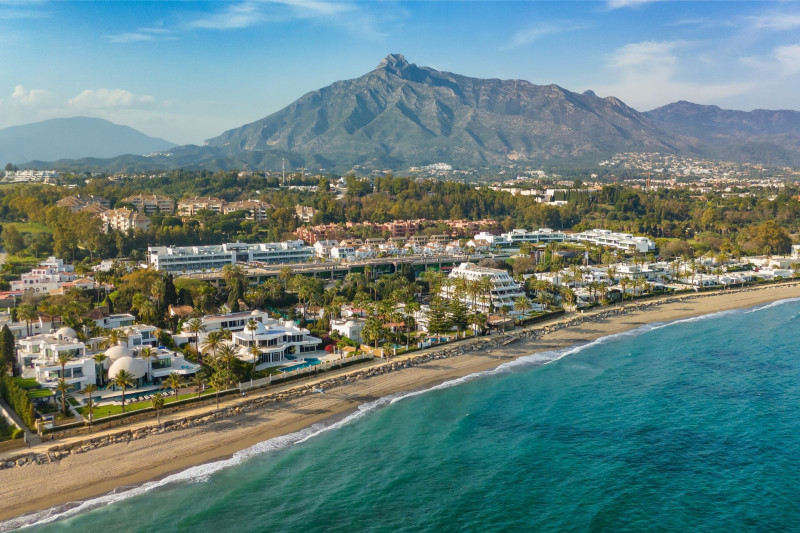
The Golden Mile remains one of Europe's most prestigious coastal addresses, stretching approximately six kilometres between central Marbella and Puerto Banús. This concentrates some of the highest-value residential real estate on the Costa del Sol, combining beachfront villas, gated communities and luxury apartments with proximity to dining, private schools and marina facilities.
Buying property here demands fluency in Spanish tax law, robust legal verification and realistic expectations about investment performance. This guide breaks down the fiscal obligations, due diligence steps and return metrics that shape Golden Mile transactions in 2026.
Overview: The Golden Mile Market in 2026
The Golden Mile property market is characterised by a limited supply of premium stock and sustained demand from international buyers, particularly from the UK, Scandinavia, the Middle East and increasingly from digital entrepreneurs seeking residency-by-investment routes. Prices reflect scarcity, with frontline beach villas commanding the highest per-square-metre valuations on the coast.
New-build luxury apartment developments have added modern inventory, but the majority of transactions involve resale properties ranging from 1980s-era villas requiring renovation to contemporary designer homes built in the past decade. Market velocity varies by property type, with well-presented turnkey villas typically selling faster than large renovation projects or outdated apartments in older complexes.
Data from the first half of 2026 shows median time-on-market for Golden Mile villas averaging 4 to 6 months, while premium apartments in established communities typically sell within 3 to 5 months. Negotiation margins between asking and achieved sale prices have narrowed over the 2025-2026 period, with villas now achieving 92 to 97 per cent of asking price on average, compared to 88 to 93 per cent in early 2025. This compression reflects tighter inventory and sustained buyer appetite across international markets.
Property Prices and Market Dynamics
At the time of writing, asking prices for Golden Mile properties span a wide spectrum. Entry-level apartments in established communities start around €500,000, while beachfront villas frequently exceed €10 million. Mid-market villas in gated urbanisations with communal pools and gardens typically range from €2 million to €5 million, depending on plot size, sea views and finish quality.
Price per square metre varies significantly based on proximity to the beach, age of construction and available amenities. Frontline beach properties command substantial premiums over second and third-line equivalents, even within the same urbanisation. Transaction volumes have remained steady through 2025 and into 2026, supported by Spain's residency-by-investment visa (the €500,000 Golden Visa threshold) and Marbella's appeal as a year-round residence rather than purely a holiday destination.
Tax Obligations for Luxury Property Buyers
Spanish property taxation applies to both the acquisition and ongoing ownership. Understanding the structure and timing of these levies is essential for accurate budgeting and cash-flow planning.
Transfer Tax (ITP) and VAT on New Builds
Resale properties in Andalucía attract Impuesto de Transmisiones Patrimoniales (ITP), a transfer tax levied by the regional government. The current rate in Andalucía is progressive: 8 per cent on the first €400,000, 9 per cent from €400,000 to €700,000, and 10 per cent on any amount above €700,000. For a €3 million resale villa, ITP totals approximately €262,000.
New-build properties are subject to VAT (IVA) at 10 per cent instead of ITP, plus Actos Jurídicos Documentados (AJD), a stamp duty currently set at 1.5 per cent in Andalucía. A new €3 million apartment therefore incurs €300,000 VAT and €45,000 AJD, totalling €345,000 in acquisition taxes.
ITP and VAT are payable within 30 working days of completion. Late payment incurs surcharges and interest, so scheduling funds transfer ahead of the notary appointment is critical.
Annual Property Taxes: IBI and Wealth Tax
Impuesto sobre Bienes Inmuebles (IBI) is the annual municipal property tax calculated on the cadastral value, a figure typically well below market value. Rates vary by municipality, but in Marbella IBI generally ranges from 0.4 per cent to 1.1 per cent of cadastral value, translating to annual bills of €2,000 to €8,000 for most Golden Mile properties, depending on plot size and location.
Wealth tax (Impuesto sobre el Patrimonio) applies to individuals resident in Spain whose worldwide net assets exceed the threshold, and to non-residents on Spanish assets only. Andalucía offers a 100 per cent reduction on wealth tax for residents at the time of writing, effectively eliminating the liability for those who establish tax residency. Non-residents remain liable on Spanish assets above €700,000, with progressive rates reaching 3.5 per cent on the highest bands. Structuring ownership through a Spanish company can alter the tax treatment, so professional tax advice is essential before acquisition.
Non-resident property owners also face Impuesto sobre la Renta de No Residentes (IRNR), an annual income tax on the deemed rental value of the property, currently 19 per cent for non-EU owners and 24 per cent for EU citizens (though bilateral treaties may reduce this). The deemed income is 1.1 per cent or 2 per cent of cadastral value depending on revision date.
Total Acquisition Cost Breakdown
To illustrate real-world budget requirements, the following table presents complete acquisition and first-year holding costs across three representative Golden Mile property tiers:
Cost Component | €1m Apartment (Resale) | €3m Villa (Resale) | 8m Beachfront Villa (Resale) |
|---|---|---|---|
Purchase Price | €1,000,000 | €3,000,000 | €8,000,000 |
ITP (Transfer Tax) | €79,000 | €262,000 | €752,000 |
AJD (Stamp Duty, Resale) | €0 | €0 | €0 |
Legal Fees (1-1.5%) | €12,000 | €36,000 | €100,000 |
Registry & Notary Fees | €3,500 | €6,000 | €12,000 |
Total Acquisition Cost | €1,094,500 | €3,304,000 | €8,864,000 |
IBI (Annual) | €2,000 | €4,500 | €10,000 |
Community Fees (Annual) | €2,400 | €8,000 | €18,000 |
Utilities & Insurance (Annual) | €1,800 | €3,500 | €6,000 |
First-Year Holding Costs | €6,200 | €16,000 | €34,000 |
Total First-Year Outlay | €1,100,700 | €3,320,000 | €8,898,000 |
Legal fees typically range from 1 to 1.5 per cent of purchase price and cover title verification, contract negotiation, representation at completion and post-completion tax filings. For properties above €5 million, fixed-fee arrangements are common. Registry and notary fees are regulated and scale modestly with transaction value.
Navigating Golden Mile acquisitions requires careful cost modelling. If you are planning a purchase and need tailored guidance on structuring, tax efficiency and legal safeguards, our team offers free initial consultations to map your acquisition strategy.
Legal Checks and Due Diligence Requirements
Spanish conveyancing is notary-led, but the burden of pre-contract verification falls squarely on the buyer and their legal representative. Gaps in due diligence can result in undisclosed debts, planning breaches or title defects that survive completion.
Nota Simple and Title Verification
The nota simple is the official extract from the Spanish Land Registry (Registro de la Propiedad) confirming registered ownership, boundaries, encumbrances, mortgages and easements. Obtaining an up-to-date nota simple is the first step in any transaction. It reveals whether the seller is the legal owner, whether charges are registered against the property, and whether any third-party rights (such as rights of way) affect the land.
Crucially, the Land Registry in Spain operates on a system of legal presumption rather than title guarantee, so discrepancies between the registry and physical reality can exist. Independent legal counsel should cross-reference the nota simple with the cadastral plan, the sale contract and any planning permissions.
Habitation Certificate and Planning Compliance
The cédula de habitabilidad (habitation certificate) confirms that the property meets minimum safety and habitation standards. While not required in all Andalucían municipalities for resale, many buyers insist on it, and mortgage lenders often demand it before releasing funds. Obtaining or renewing the certificate can take several weeks and may require remedial works if defects are identified.
Planning compliance verification involves confirming that all built structures correspond to licensed plans and that no illegal extensions, pools or boundary changes have been made. The certificado de final de obra (completion certificate) and licencia de primera ocupación (first-occupation licence) are key documents for new builds. For older properties, retrospective legalisation of minor infractions is sometimes possible, but significant breaches can render a property unsellable or subject to demolition orders.
The Certificado AFO (Asimilado a Fuera de Ordenación) applies to properties built before planning regulations came into force or to structures that predate zoning rules. Obtaining AFO status can protect buyers from demolition risk for older properties that do not fully comply with current planning codes.
Community Fees and Charges
Most Golden Mile properties sit within private urbanisations governed by a community of owners. The statutes (estatutos) and community rules set annual fees, reserve funds and regulations on renovations, rentals and use. Buyers should request a certificate from the community administrator (administrador de fincas) confirming that the vendor has no outstanding debts, as these follow the property and become the buyer's liability upon transfer.
Community fees on the Golden Mile vary widely, from €1,200 per year for modest apartments to €20,000 or more for villas in full-service gated communities with 24-hour security, landscaped gardens, spa facilities and beach clubs. Special assessments for major repairs (such as facade renovation or lift replacement) can add unexpected costs, so reviewing recent community meeting minutes is prudent.
Legal Due Diligence Timeline: A Step-by-Step Checklist
To provide actionable structure, the following numbered timeline outlines the conveyancing process from reservation to completion:
- Reserve Property and Obtain NIE: Pay a reservation deposit (typically 10 per cent of purchase price) to remove the property from the market. Simultaneously apply for your NIE (Número de Identificación de Extranjero), the Spanish tax identification number required for all property transactions. The NIE can be obtained at Spanish consulates abroad or in Spain within 7 to 10 working days.
- Lawyer Conducts Nota Simple and Town Hall Checks (7-10 Days): Your appointed lawyer orders the nota simple from the Land Registry, verifies ownership and encumbrances, and requests certificates from the town hall (ayuntamiento) confirming IBI payments are current, no debts are registered, and planning compliance is in order.
- Arrange Survey and AFO Certificate Pre-Completion: Commission an independent structural survey if buying an older villa or a property requiring renovation. If the property predates current planning regulations, ensure the AFO certificate is in place before exchanging the private contract.
- Sign Private Contract and Pay Remaining Deposit: Once due diligence is satisfactory, execute the contrato de compraventa (private purchase contract) and transfer the balance of the deposit (often bringing total deposit to 20 to 30 per cent). This contract is legally binding and establishes the completion date, penalty clauses and conditions precedent.
- Final Completion at Notary with Balance Transfer and Tax Payment: On the agreed completion date, both parties attend the notary's office (notaría). The buyer transfers the balance purchase price, the seller delivers keys and title, and the notary reads and formalises the escritura pública (title deed). ITP or VAT must be paid within 30 days of this notarial act, and the buyer's lawyer typically handles this filing with the regional tax office.
Following this sequence minimises risk and ensures all statutory checks are completed before funds leave your control.
Investment Returns: Rental Yield, Holding Costs and Exit Strategy
Golden Mile property is often positioned as a lifestyle asset rather than a pure investment, but understanding realistic returns is essential for tax planning and portfolio allocation.
Rental Income and Regulatory Constraints
Short-term holiday rentals on the Golden Mile have faced increasing regulatory scrutiny. New licensing requirements in Marbella and across Andalucía limit the availability of short-let licences for apartments in certain zones, and many communities prohibit tourist rentals altogether under their statutes. As a result, achievable rental yields for properties that can be legally rented short-term typically range from 3 to 4 per cent gross, before deducting management fees (usually 15 to 25 per cent of rental income), maintenance and periods of vacancy.
Long-term rentals to year-round residents or expatriate families generate lower yields, often 2 to 3 per cent gross, but involve less management and comply with community rules. Buyers intending to derive rental income should verify the legal status of the property for tourist letting before completion and factor in the cost of obtaining or renewing the necessary licences.
Five-Year Investment Return Scenario
The following worked example models a five-year hold period for a €3 million Golden Mile villa purchased in 2026:
Acquisition (2026):
- Purchase price: €3,000,000
- ITP: €262,000
- Legal and registry fees: €42,000
- Total acquisition cost: €3,304,000
Annual Holding Costs:
- IBI: €4,500
- Community fees: €8,000
- Insurance: €2,000
- Maintenance and gardening: €6,000
- Total annual holding: €20,500
Rental Income:
- Gross annual rental yield at 3.5%: €105,000
- Less management (20%): €21,000
- Net annual rental income: €84,000
Five-Year Net Rental Income:
- Total gross rental: €525,000
- Less total holding costs (€20,500 × 5): €102,500
- Less management fees: €105,000
- Net rental income over five years: €317,500
Exit (2031):
- Sale price (assuming 3% annual capital appreciation): €3,477,814
- Less estate agency commission (3%): €104,334
- Less plusvalía municipal (estimated): €15,000
- Net sale proceeds before capital gains tax: €3,358,480
Capital Gains Tax (Non-Resident):
- Gain: €3,358,480 - €3,304,000 = €54,480
- Capital gains tax at progressive rates (19% on first €6,000, 21% on €6,000-€50,000, 23% thereafter): approximately €11,880
- Net proceeds after CGT: €3,346,600
Overall Return:
- Initial investment: €3,304,000
- Net sale proceeds: €3,346,600
- Net rental income: €317,500
- Total return: €360,100 over five years
- Simple annualised return (not IRR): approximately 2.2% per annum
This scenario assumes moderate capital appreciation and conservative rental performance. It excludes currency fluctuation, financing costs (if a mortgage is used), and any major capital expenditure such as renovation or pool refurbishment. The effective IRR, accounting for the timing of rental receipts and the capital return at exit, would be slightly higher but remains modest compared to liquid financial assets.
For buyers considering leveraged purchases, mortgage availability and terms vary significantly for non-residents. Loan-to-value ratios for foreign buyers typically max out at 60 to 70 per cent, and interest rates reflect the lender's perception of credit risk and currency exposure.
The Golden Mile therefore appeals primarily to buyers prioritising lifestyle, residency optionality and portfolio diversification over maximising income yield. Those seeking higher returns may compare the Spanish market with alternative jurisdictions and evaluate residency-by-investment programmes in neighbouring countries.
Frequently Asked Questions
What taxes apply when buying Golden Mile property?
Resale properties incur Impuesto de Transmisiones Patrimoniales (ITP) at progressive rates of 8 per cent, 9 per cent and 10 per cent depending on value bands, totalling approximately €262,000 on a 3 million villa. New-build properties attract 10 per cent VAT plus 1.5 per cent AJD stamp duty. Annual liabilities include IBI municipal tax (€2,000 to €8,000 typically), wealth tax for non-residents on assets above €700,000, and non-resident income tax on deemed rental value at 19 to 24 per cent of 1.1 to 2 per cent of cadastral value.
Do I need a Spanish tax ID before purchase?
Yes, the NIE (Número de Identificación de Extranjero) is mandatory for all property transactions in Spain. You cannot sign contracts, open a Spanish bank account or complete a purchase without it. The NIE application takes 7 to 10 working days and can be processed at Spanish consulates abroad or directly in Spain. Most buyers apply at the reservation stage, immediately after paying the initial deposit, to avoid delays in the conveyancing timeline.
How long does conveyancing take in Marbella?
Typical Golden Mile conveyancing spans 8 to 12 weeks from offer acceptance to completion, though complex chains or planning issues can extend this. Initial due diligence (nota simple, town hall checks) takes 7 to 10 days. Survey and AFO certificate procurement adds 2 to 4 weeks. The private contract is usually signed 4 to 6 weeks after reservation, with final notarial completion 4 to 6 weeks thereafter. Efficient legal representation and clear title records accelerate the process significantly.
What are typical legal fees for a €3m villa?
Legal fees for a €3 million Golden Mile villa range from €30,000 to €45,000 (1 to 1.5 per cent of purchase price). This covers full due diligence, contract negotiation, representation at notarial completion and post-completion tax filings. Registry and notary fees add approximately €6,000, regulated and scaling modestly with transaction value. For properties above €5 million, many firms offer fixed-fee arrangements. Always confirm scope in writing before engagement to avoid cost creep.
Can non-EU buyers get mortgages in Spain?
Yes, non-EU buyers can access Spanish mortgages, though loan-to-value ratios are typically capped at 60 to 70 per cent compared to 80 per cent or more for residents. Interest rates reflect credit risk and currency exposure, often 100 to 200 basis points above resident rates. Lenders require proof of income, bank statements, tax returns and a valuation of the property. Processing takes 4 to 8 weeks. Some UK and international banks offer euro-denominated mortgages secured on Spanish property, which may provide more competitive terms for sterling earners.
Conclusion: Structuring Your Golden Mile Acquisition
The Golden Mile offers unmatched lifestyle appeal and enduring prestige, but buyers must approach transactions with clear-eyed financial planning and rigorous legal verification. Acquisition taxes alone add 9 to 11 per cent to the headline price, annual holding costs for premium properties can exceed €30,000, and rental yields rarely match those available in urban buy-to-let markets elsewhere.
Successful acquisitions hinge on early NIE application, comprehensive due diligence covering title, planning and community debts, and realistic modelling of holding costs and exit taxes. The legal timeline from reservation to completion spans 8 to 12 weeks, and buyers should engage independent Spanish legal counsel from the outset to verify all claims made by vendors and agents.
For those prioritising residency, security and quality of life over pure financial return, the Golden Mile remains a compelling proposition. If you are considering a purchase and want to model total acquisition costs, explore financing options or understand the tax implications of ownership structures, our team offers free consultations to guide your next steps. Contact us to begin structuring your Golden Mile acquisition with confidence.