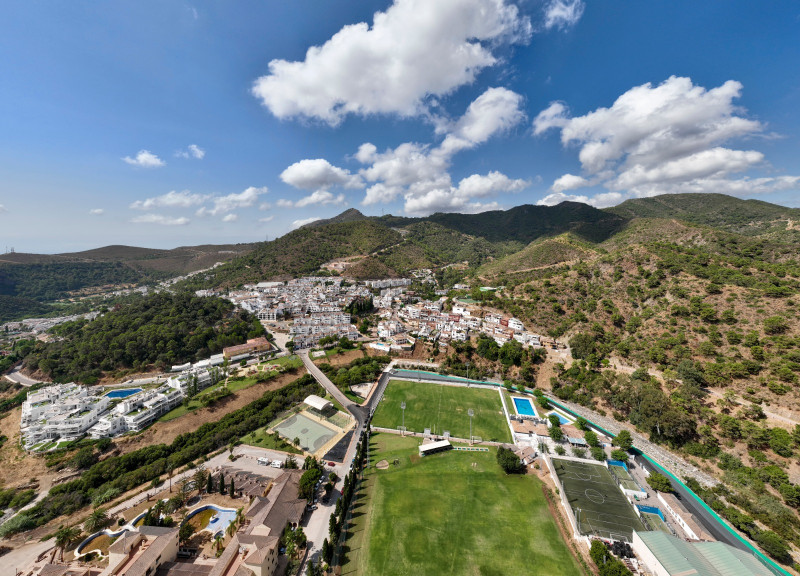
La Quinta sits in the hills above the Costa del Sol, within the municipality of Benahavis, and has become one of the western Costa's most sought-after residential addresses. The area combines proximity to Marbella and Puerto Banús with a quieter, golf-oriented lifestyle that appeals to families, retirees and second-home buyers looking for space, privacy and year-round sunshine.
This guide covers what defines La Quinta, the property market in 2026, amenities, location advantages and who typically buys here.
What Is La Quinta, Benahavis?
La Quinta is a residential neighbourhood centered on the La Quinta Golf & Country Club, approximately 8 kilometres inland from the Mediterranean coast. Administratively it falls within Benahavis, a municipality known for low property taxes and a concentration of luxury developments scattered across wooded hillsides between Marbella and Estepona.
The area developed around its golf resort and has expanded over the past three decades into a collection of villa plots, gated communities and low-rise apartment complexes. Unlike the high-density coastal strip, La Quinta retains a semi-rural character with mature landscaping, mountain views and relatively generous plot sizes.
Access is via the A-7 coastal motorway (exit at San Pedro de Alcántara) or the AP-7 toll road, with Málaga-Costa del Sol Airport roughly 60 kilometres to the east. The drive to Puerto Banús marina takes about ten minutes, Marbella's old town around fifteen.
Property Types and Architecture in La Quinta
La Quinta's housing stock divides into three main categories.
Detached villas dominate the landscape. Most sit on plots of 800 to 2,000 square metres and range from traditional Andalusian styles (whitewashed walls, terracotta roofs, arched loggias) to contemporary designs with flat roofs, floor-to-ceiling glass and infinity pools. Four and five-bedroom layouts are typical, with garages for two or three cars and landscaped gardens.
Gated communities offer terraced villas, townhouses and ground-floor apartments, usually built around communal pools, gyms and landscaped gardens. Security is a selling point, and many developments include 24-hour concierge services. These properties appeal to lock-up-and-leave buyers who spend part of the year elsewhere.
Golf-adjacent apartments cluster near the clubhouse and hotel. Two and three-bedroom units with terraces overlooking fairways are common, and some offer direct buggy access to the course.
Build quality varies by age and developer. Properties from the early 2000s often need modernisation (kitchens, bathrooms, air-conditioning systems), while newer builds incorporate home automation, underfloor heating and energy-efficient glazing.
Price Guide: What Properties Cost in La Quinta
Property prices in La Quinta reflect its position in the mid-to-upper tier of the Costa del Sol market. The area sits below the ultra-luxury enclaves of Sierra Blanca or Los Flamingos but commands a premium over inland villages and coastal high-rises.
At the time of writing, asking prices break down roughly as follows:
- Apartments and townhouses: €300,000 to €800,000. Smaller two-bedroom apartments in older complexes start around €300,000, while larger three-bedroom corner units or penthouses in well-maintained communities reach €700,000 to €800,000.
- Mid-range villas: €800,000 to €2 million. Four-bedroom detached villas on plots of 1,000 to 1,500 square metres typically fall into this bracket. Condition, views and proximity to the golf course influence pricing.
- High-end and contemporary villas: €2 million to €5 million and beyond. Newly built or comprehensively renovated properties with panoramic sea or mountain views, designer finishes and resort-style gardens occupy the top of the market.
Benahavis municipality levies an annual property tax (IBI) that is notably lower than neighbouring Marbella, one reason developers and buyers favour the area. Typical IBI bills for a villa worth €1.5 million might be €1,500 to €2,000 per year, compared to €3,000 or more for a similar property in Marbella's urban core.
If you are considering buying or selling in La Quinta, a professional market appraisal will clarify current values and help you position a property correctly. Arrange a viewing tour of La Quinta to understand what your property could achieve in the present market.
La Quinta vs Nearby Areas: Comparative Overview
The table below positions La Quinta against neighbouring developments, highlighting price, tax, location and buyer demographics that define each area.
Area | Avg. Villa Price | IBI Rate (indicative) | Distance to Coast | Golf Courses | Typical Buyer Profile |
|---|---|---|---|---|---|
La Quinta | €1.2–2.5m | 0.4–0.5% (Benahavis) | 8 km | 1 (27 holes) | Northern European families, golf-focused retirees, UK/Scandinavian second-home owners |
Nueva Andalucía | €1.5–3m | 0.6–0.7% (Marbella) | 4 km | 3 (Aloha, Los Naranjos, Las Brisas) | Golf enthusiasts, young professionals, luxury rental investors |
San Pedro de Alcántara | €800k–1.8m | 0.6–0.7% (Marbella) | 0.5 km | 0 (nearest 5 min drive) | Families seeking beach access, permanent residents, Spanish buyers |
Los Arqueros | €900k–2m | 0.4–0.5% (Benahavis) | 10 km | 1 (18 holes) | Retirees, remote workers, privacy-focused buyers |
La Quinta's combination of Benahavis taxation, golf infrastructure and family-friendly positioning gives it a distinct profile within the broader Marbella catchment.
Golf and Lifestyle Amenities
La Quinta Golf & Country Club forms the heart of the community. The 27-hole championship course (designed by Manuel Piñero and reopened after renovation) attracts members and visiting golfers throughout the year. The clubhouse includes a pro shop, restaurant and practice facilities.
Beyond golf, residents rely on a mix of on-site and nearby amenities:
- Fitness and wellness: The La Quinta spa and gym offer yoga, pilates, personal training and treatments. Several private tennis and padel clubs operate within a five-minute drive.
- Dining: The area itself has limited restaurants, most of them attached to the golf club or hotel. For broader choice, residents drive to San Pedro de Alcántara (ten minutes) or Puerto Banús (similar distance), where the restaurant scene ranges from casual chiringuitos to Michelin-starred establishments.
- Shopping: Day-to-day groceries are available at small supermarkets in San Pedro. Larger Mercadona, Lidl and Carrefour branches sit along the coastal road. Puerto Banús and Marbella provide designer boutiques, department stores and speciality shops.
The lifestyle is quiet and suburban. Families value the lack of through-traffic and the outdoor space. Retirees appreciate the walkability of golf-course loops and the ease of organising social rounds. The trade-off is car dependency: almost every errand requires a short drive.
Location: Access to Marbella, Puerto Banús and Beyond
La Quinta occupies a middle ground between coastal bustle and mountain seclusion. The area is close enough to Marbella and Puerto Banús for convenience but far enough to avoid the summer crowds and traffic.
Marbella old town (around 15 minutes by car) offers historic plazas, tapas bars, twice-weekly markets and a year-round cultural calendar. Puerto Banús (10 minutes) provides the marina, nightlife, luxury retail and beach clubs that define the high-end Costa del Sol experience.
Estepona lies 20 minutes to the west. The town has undergone significant regeneration, with a pedestrianised old quarter, seafront promenade and a growing expat community.
Ronda, the dramatic mountain town, sits about 45 minutes inland and makes a popular day trip. Málaga city (roughly an hour's drive) combines museums, gastronomy and an international airport with direct flights to over 100 destinations.
The AP-7 toll motorway runs parallel to the coast and bypasses most local traffic, cutting journey times to the airport and Gibraltar (around 75 minutes). The free A-7 can be slower during peak summer and holiday weekends.
Schools and Family Infrastructure Near La Quinta
La Quinta appeals to international families, and several well-regarded schools operate within a 20-minute radius:
- Laude San Pedro International College (San Pedro de Alcántara) offers British curriculum education from nursery through Sixth Form, with IGCSEs and A-levels.
- Aloha College (Nueva Andalucía) follows the British system and has a long-established reputation among expatriate families.
- The English International College (Marbella) provides another British-curriculum option.
- Swans International School (Marbella) caters to younger children with a Montessori-influenced approach.
- Colegio Alborán and Colegio Alboran Marbella serve Spanish-curriculum students, including those preparing for university entrance in Spain.
Most schools run their own bus services covering La Quinta and surrounding developments. Extracurricular activities (sport, music, drama) are extensive, and parent networks are active.
Childcare for pre-school ages is available through private nurseries in San Pedro and Nueva Andalucía. Healthcare is well covered: private clinics (including Hospital Costa del Sol and Quirónsalud Marbella) are within 15 minutes, and most expatriates carry private health insurance to access English-speaking consultants.
Who Buys in La Quinta
La Quinta attracts a diverse but identifiable buyer demographic, shaped by the area's golf focus, international school access and semi-rural setting.
Northern European families form a core group. British, Scandinavian and German buyers with school-age children are drawn to the proximity of Aloha College (five minutes) and Laude San Pedro (eight minutes), both of which deliver British curriculum education and well-developed pastoral support. The villa typology suits larger families, and the gated-community model offers security and social networks for parents who may spend several years in Spain before returning home or relocating.
Golf-focused retirees represent another significant segment. Many have played La Quinta's course as visitors and choose to buy once they decide to spend extended periods or retire full-time to the Costa del Sol. The combination of year-round playability, temperate winters and easy access to a dozen other courses within 15 minutes makes the area a logical base. Healthcare quality and the presence of established expatriate clubs (bridge, walking groups, social lunches) reinforce the appeal.
UK and Scandinavian second-home owners use La Quinta properties for holiday breaks, typically spending six to twelve weeks a year on the coast. Lock-up-and-leave security, property management services and short-term rental potential when the villa sits empty underpin this model.
Remote workers have emerged as a growing buyer category. Technology professionals, consultants and creatives who operate across time zones value the reliable fibre broadband, the home-office-friendly villa layouts and the lifestyle balance between focused work and outdoor recreation. Málaga airport's direct connections to northern Europe simplify business travel when face-to-face meetings are required.
Community profiles differ by development. Older, established complexes skew towards retirees and long-term residents. Newer builds attract younger families and professionals. The golf club itself serves as a social anchor, and many residents report that club membership accelerates integration into the local expatriate community.
Planning and Development Outlook
La Quinta's development pipeline has slowed compared to the intense construction phase of the early 2000s, but activity continues at a measured pace.
Recent planning approvals have favoured infill villa plots and the replacement of older properties with contemporary designs. The Benahavis town hall has maintained relatively permissive planning policies for single-family homes on larger plots, provided developments respect density limits and environmental guidelines. Several boutique villa projects (typically four to six units) broke ground in late 2025 and are scheduled for completion in 2027.
Infrastructure investment has improved connectivity and service quality. The access road from the A-7 was resurfaced and widened in 2024, reducing congestion during peak hours. Fibre-optic broadband reached most of La Quinta by early 2025, with providers offering symmetrical gigabit packages. Water and sewage networks have been upgraded in older sections, addressing capacity constraints that previously caused issues during dry summers.
The resale-to-new-build split currently favours resale stock. Roughly 70 per cent of transactions involve existing properties, many of which undergo renovation before or shortly after sale. Buyers often prefer established plots with mature gardens and the ability to customise interiors, rather than waiting for off-plan delivery. New builds command a premium (typically 15 to 20 per cent above equivalent resale) but attract buyers seeking modern energy standards, warranties and turnkey delivery.
No large-scale commercial or mixed-use schemes are planned. La Quinta's character as a low-density, residential and leisure-oriented enclave appears secure in the medium term.
Rental Yield and Investment Potential
La Quinta offers modest but stable returns for buy-to-let investors, with performance heavily influenced by property type, condition and management quality.
Gross rental yields for well-maintained villas typically fall in the 4 to 5 per cent range, based on annual rental income divided by purchase price. A villa bought for €1.2 million and generating €50,000 to €60,000 per year would sit at the upper end of this band. Golf-adjacent apartments deliver slightly lower yields (3 to 4 per cent) due to higher purchase prices relative to achievable rents, but they benefit from lower maintenance costs and appeal to short-stay guests.
Occupancy rates vary seasonally. Peak rental season runs from June through September, when families and golfers from northern Europe seek sun and access to courses that remain playable through the summer heat. Shoulder months (April, May, October) also perform well, particularly among retirees and golf groups. Winter bookings are lighter but improving, supported by the growth in remote working and the appeal of mild coastal winters.
A well-marketed villa with pool, garden and golf-course views might achieve 30 weeks of paid occupancy per year, generating €50,000 to €70,000 depending on size and specification. Deduct community fees (€2,000 to €5,000 annually), property management (typically 15 to 20 per cent of rental income), maintenance, insurance and IBI, and net yields compress to around 3 to 3.5 per cent.
Clientele comprises golfers (often groups of four to eight staying for a week), families seeking villa holidays with space and privacy, and occasionally corporate guests attending events or meetings in Marbella. Properties that accept short lets (minimum stays of three to seven nights) generate higher gross income but incur more frequent turnovers and cleaning costs.
La Quinta does not compete with coastal hotspots for raw rental yield, but investors value the combination of capital appreciation (historically 3 to 5 per cent per year in euro terms), personal use and relatively predictable demand. Buyers often treat rental income as a contribution to running costs rather than a standalone return.
Practicalities: Buying, Taxes and Ownership
Spain permits non-residents to buy property without restriction. The process involves obtaining a foreigner identification number (NIE), opening a Spanish bank account and instructing a lawyer to conduct due diligence on title, debts and planning compliance.
Buyers pay transfer tax (ITP) at 7 per cent on resale properties in Andalucía, or VAT at 10 per cent plus stamp duty at 1.5 per cent on new builds. Legal fees typically run at 1 to 1.5 per cent of purchase price. Notary and land registry costs add another few hundred euros.
Annual obligations include IBI (property tax), rubbish collection (basura, usually a few hundred euros per year) and community fees if the property sits within a development. Non-resident owners also file an annual tax return (Modelo 210) declaring imputed income on the property, calculated at 1.1 to 2 per cent of cadastral value. If the property is rented, rental income is taxed at 19 per cent (EU residents) or 24 per cent (non-EU).
Inheritance and gift taxes vary by relationship and region, but Andalucía offers generous allowances for close family members. Professional estate planning advice is recommended for high-value properties.
Frequently Asked Questions
Is La Quinta part of Marbella or Benahavis?
La Quinta falls within the municipality of Benahavis, not Marbella, despite its proximity to Marbella's western edge and Puerto Banús. The administrative boundary runs just east of the development. Benahavis municipality is known for lower property taxes (IBI) than Marbella, which makes La Quinta attractive to buyers comparing running costs. Postal addresses reference Benahavis, and local taxes and planning permissions are handled by Benahavis town hall. However, residents typically rely on Marbella and San Pedro for most daily services.
What is IBI tax in La Quinta vs Marbella?
IBI (Impuesto sobre Bienes Inmuebles) in Benahavis municipality, which covers La Quinta, is charged at roughly 0.4 to 0.5 per cent of the cadastral value. A villa with a cadastral value of €400,000 might incur an annual IBI bill of €1,600 to €2,000. Marbella's IBI rate is higher, typically 0.6 to 0.7 per cent, meaning a similar property in Marbella town could cost €2,400 to €2,800 per year. The difference accumulates over time and is one reason buyers favour Benahavis addresses for investment and second-home purchases.
How far is La Quinta from the beach?
La Quinta sits approximately 8 kilometres inland from the Mediterranean coast. The nearest beaches are at San Pedro de Alcántara, roughly a ten-minute drive via the A-7 coastal road. Puerto Banús beach clubs and the Marbella seafront lie within a similar distance. The elevation (La Quinta ranges from 150 to 250 metres above sea level) means residents sacrifice beachfront convenience for hillside views, quieter surroundings and typically larger plots. Most owners drive to the coast for swimming, water sports or dining at chiringuitos.
Are there international schools nearby?
Several well-established international schools serve La Quinta families. Aloha College in Nueva Andalucía is a five-minute drive and offers British curriculum education from early years through A-levels. Laude San Pedro International College, around eight minutes away in San Pedro de Alcántara, follows a similar British system. The English International College and Swans International School, both in Marbella, lie within 20 minutes. Most schools operate bus routes covering La Quinta and surrounding developments, and extracurricular programmes (sports, music, languages) are extensive. School proximity is a major draw for northern European families.
Can non-residents buy property in La Quinta?
Yes, non-residents can buy property in La Quinta and anywhere in Spain without needing residency or citizenship. Buyers must obtain a foreigner identification number (NIE) from the Spanish authorities, open a Spanish bank account and instruct a lawyer to conduct title checks and handle the purchase deed. EU and non-EU buyers face the same process. Non-residents who do not spend more than 183 days per year in Spain remain liable for non-resident taxes (Modelo 210) on imputed income or rental earnings, but ownership itself carries no residency requirement. Financing is available from Spanish banks, though non-residents typically need larger deposits.
What are annual community fees in La Quinta?
Community fees (cuotas de comunidad) vary widely depending on the development's facilities and management structure. Gated communities with 24-hour security, landscaped gardens, communal pools, gyms and concierge services typically charge €2,000 to €5,000 per year for a villa or townhouse. Smaller, low-amenity complexes may levy €1,000 to €2,000 annually. Golf-adjacent apartments often incur fees at the lower end of this range due to shared costs across more units. Fees cover maintenance, insurance, water for common areas, lighting and staffing. Standalone villas on private plots do not pay community fees but carry higher individual running costs.
What rental income can a La Quinta villa generate?
A well-maintained four-bedroom villa with pool and golf views in La Quinta can achieve gross rental income of €50,000 to €70,000 per year, based on approximately 30 weeks of paid occupancy. Peak season (June to September) commands weekly rates of €2,000 to €3,500, while shoulder months (April, May, October) drop to €1,500 to €2,500 per week. Deduct property management fees (15 to 20 per cent of rental income), community charges, maintenance, insurance and IBI, and net yields typically fall in the 3 to 3.5 per cent range. Golf-adjacent apartments generate lower absolute income but similar percentage yields. Rental performance depends heavily on marketing, property condition and flexibility on minimum stay durations.
Does La Quinta suit permanent year-round living?
La Quinta suits permanent living for buyers who value space, golf access and a quieter lifestyle but do not require walking-distance amenities or beach proximity. The area is car-dependent: almost every errand (groceries, dining, healthcare, schools) requires a drive of five to fifteen minutes. Winters are mild and the golf course remains playable year-round, which appeals to retirees and remote workers. Families appreciate the international schools and the established expatriate community. However, the lack of a village centre or high street means social life revolves around private clubs, school networks and coastal towns rather than local街 corner cafés or weekly markets.
Next Steps
La Quinta combines golf, international schools, Benahavis tax efficiency and proximity to Marbella in a single semi-rural package. The area suits families, retirees and second-home buyers who prioritise space and a quieter lifestyle over beachfront convenience.
If you are exploring options in La Quinta or comparing developments across the western Costa del Sol, professional guidance will clarify which property type and location aligns with your budget and priorities. Speak to a Benahavis specialist to arrange viewings, access off-market listings and receive up-to-date market analysis.